Announcements and E-formation -- June 24, 2026
.jpg)
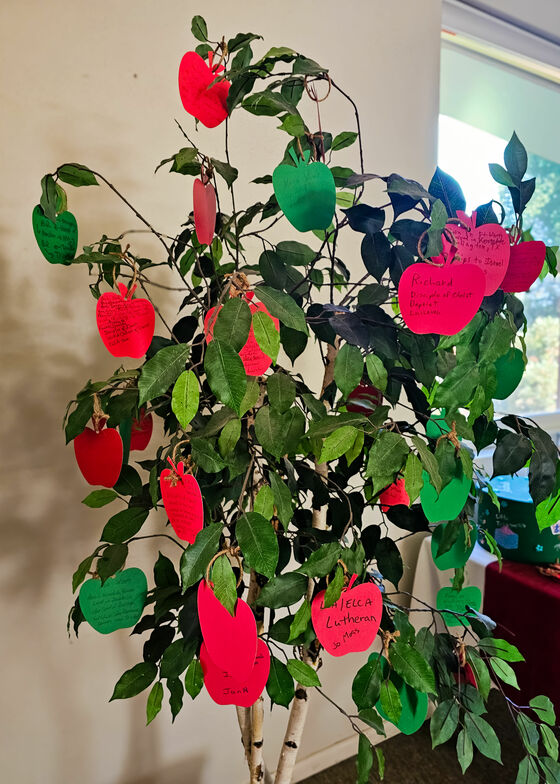
Producing Good Fruit
By Pr. Lisa Rygiel
In our book club on Wednesdays, we have been working our way through a book by Skye Jethani Entitled What if Jesus was Serious? In this book, we compare Jesus’ teachings presented in the Sermon on the Mount and how most Christians live. Skye illustrates how we explain away elements of Christ’s longest lesson of ethical teaching and how our lives might look different if we really did exactly what he says.
Last week, one of our topics was how Christians produce good fruit. According to Skye, we live in a self-improvement culture. We believe whatever is undesirable, deficient, or underdeveloped in us can be changed with just the right combination of knowledge and willpower. I just need to read the right book, get into the right program, or work the right system to be who we want to be. However, Jesus compares people to trees. The fruit a tree produces is based on the identity of the tree. A good tree will produce good fruit; a bad tree will produce bad fruit. Fruit just happens.
And this perplexes Christians in our self-improvement culture. When we read in Galatians 5 that the fruits of the Spirit are “love, joy, peace, patience, kindness, generosity, faithfulness, gentleness, and self-control”, we want to know what program we need to develop these fruits. Yet our focus is on the wrong place. According to Sky, “the call of Christ is not to improve our fruit but to instead seek the transformation of our identity. Our old selves must be uprooted and a new self-planted in God.”
I challenged the class to come up with ideas on how we can uproot ourselves and replant ourselves in God. I thought they came up with a pretty great list and I wanted to share!
- Prayer
- Coming to church
- Spending time with the faithful
- Focusing on the liturgy
- Passing the peace
- The confession and the repentance
- Accepting others
- Communion
- Time in the Word
- Being mindful of our identities in Christ
If we do these things (and I am sure you can think of others), we become trees, rooted in God and thriving on His Spirit. Then, we will naturally produce His good fruit.
5th Sunday in Pentecost, June 28
Worship at 10 a.m.
Announcements
- Fellowship: Join us after worship today in the Fellowship Hall for coffee & conversation. All are welcome.
- Wednesday Book Club: We will not meet July 1 but will resume on July 8.
- Time of Prayer and Coffee: We are invited to join our siblings in Christ from the Methodist church for a time of prayer and coffee at 10:30 a.m. each Thursday at Kangaroo Coffee -in the Marketplace on Commercial Street.
- 5-Loaves Volunteers Needed: Our next 5-Loaves delivery is Saturday, June 27. We are still seeking volunteers to assist with deliveries that day, as well as with preparations on Friday morning. If you can assist, please let Norine Hazen, Jo Moss, or Terri Watson know.
- Summer Supper Gatherings: At 5:30 p.m. on the second Wednesday of each summer month, we will gather in the Fellowship Hall for food and fun. The next evening of food and fun is scheduled for at 5:30 p.m. on Wednesday, July 8. Other dates are Aug. 12 and Sept. 9. There is a sign-up sheet in the Fellowship Hall for food and activities. If you have questions, please let Julie Wersal or Jo Moss know.
- Worship Assistance Lists: We are updating the worship assistance list for July and August. If you are willing to help with ushering, communion preparation and clean up, or lector, please let Pr. Lisa or Jo Moss know. We will share the updated list for the coming months next Monday.
- Annual Garage Sale: The annual Zion’s Garage Sale will be Saturday, Aug. 1. If you have items to donate, please let Julie Wersal know. We will begin accepting drop offs beginning July 24. Please be aware that while Zion’s can accept most items for the sale, we cannot accept electronic or computer items and we do not accept clothing and shoes either.
- We’re Here for You: For pastoral care, call Zion’s at 719-846-7785 or send an email: zionsluth@gmail.com.
E-Formation
This coming Sunday is “a cup of cold water” Sunday. Come to worship, to remember the cold water of your baptism and to be strengthened to offer water to a very thirsty world.
Matthew 10:40-42
In a time of disagreement as to which traveling preachers ought to have authority in the church, Matthew, using the Old Testament designation of “prophet,” claimed that the legitimate teachers bear the authority of the name of Jesus and embody the power of God. This passage, the conclusion of Matthew’s second discourse, follows last week’s words about taking up the cross: thus “the reward” of which Matthew speaks is ambiguous.
Jeremiah 28:5-9
In another of Jeremiah’s adventures, he had donned an oxen yoke as a sign of the Babylonian domination of Judah. In this passage, Jeremiah denounced Hananiah as a false prophet who was speaking easy and welcome words about divine blessing and the end of the exile. Jeremiah warned that words about peace might not be the word of God.
Romans 6:12-23
Continuing through his letter to the church in Rome and writing in the Greco-Roman culture that assumed a slave economy in which most people served those placed above them, Paul employed the metaphor of slavery to describe the powerful domination of sin. Paradoxically, freedom in Christ is also slavery to God.
Zion's Lutheran Church
zionsluth@gmail.com
719-846-7785
-
Location
Office Hours
Contact
